Client Advisory Services: How Accountants Can Stay Indispensable in an AI World
I’ve spent the last 13+ years sifting through founder meetings, and the biggest surprise is this: most aren’t asking for “cleaner books”. They’re wondering, “Am I going to be okay?”
They’ve got payroll coming, a major customer wobbling, a key hire to make, and they’re making decisions in the dark. The financial might be done and delivered but they don’t feel clear. That’s where Client Advisory Services (CAS) comes in. It’s not about just closing the books but turning the numbers into decisions, de-risking, and a plan you can actually run.
Why is CAS essential for your clients and for your firm?
Businesses are operating with thinner margins and navigating more uncertainty than they’re comfortable admitting. They don’t just want historical financials or financial pro formas. They want guidance. They need a partner who is an extension of their team and can clearly translate numbers into decisions.
I believe that the CAS is the bridge between “here’s what happened” and here’s what to do next.” And as routine work gets commoditized, firms that win will be the ones who consistently turn financials and dashboards into decisions.
Moreover, for firms, CAS addresses an equally important challenge: differentiating the value proposition. If your primary revenue source is producing compliance deliverables, you are increasingly in a price war because automation and AI will continue to drive down the cost of routine work. (This is why GrowthLab startedSTRMS.io in 2022). That doesn’t mean
accounting compliance isn’t important; it just means it is becoming less of a premium offering.
I meet with many firm owners, and here’s what they won’t say out loud: advisory services often break down not because accountants lack expertise but because advisory is difficult to price, impossible to scale, and offered sporadically or reactively.
CAS wins when you turn it into a repeatable, prescribed operating system, and not an occasional “nice conversation.”
AI changes the game, but not the way most accountants fear
There are two versions of the AI conversation in accounting right now: Hype and reality.
No doubt AI is compressing the time and cost of routine work such as coding, reconciliations, and first-pass reviews, not to mention insights. The client baseline expectations are rising. The value shifts from producing financials and reports to interpreting with judgement and trust.
AI Insights can tell a client what changed but CAS helps them decide what to do about it and what to do next.

The human side now enters the equation. Clients won’t be hiring an accountant because we love spreadsheets; they hire because they want greater confidence and someone who can bring calm to complexity and clarity to the chaos.
I think of it as “Automation buys time.” Trust and unreasonable hospitality earns you relevance.
The GrowthLab approach: It’s all about Cadence + Rigor + People
At GrowthLab, we’ve always appreciated that advisory scales when you treat it like a product. Simply put, standardize parameters and pricing, backed by documented process, a defined scope, and fixed monthly fee. That’s how you solve for the sporadic advisory challenge without losing humanity and hospitality.
We obsess over these two words:
cadence and
rigor. Here’s our way to explain CAS: if you want CAS to scale, you need rhythm your people can repeat and your clients can rely on.
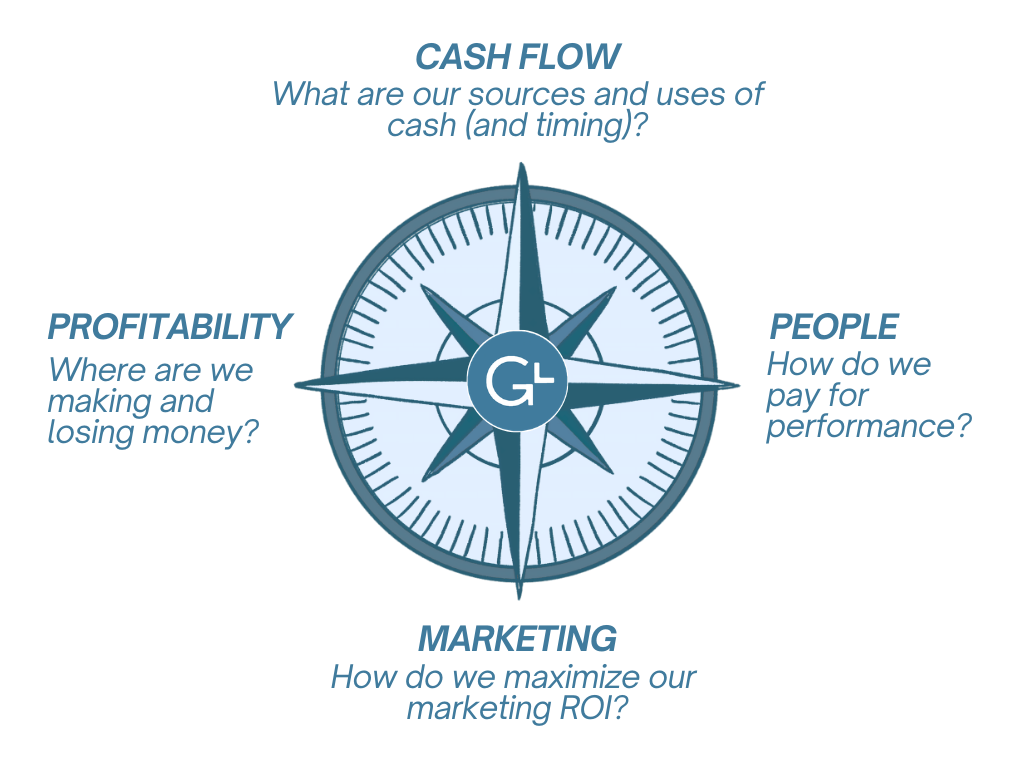
The GrowthLab 4: The four questions we ask every month - Our CAS Compass
The GrowthLab 4 is core to how we keep advisory grounded, practical and relevant:
- Cashflow - What are our sources and uses of cash (and timing)?
- Profitability - Where are we making and losing money?
- People - How do we pay for performance?
- Marketing - How do we maximize our marketing ROI?
And what does CAS look like in the trenches (a monthly recurring workflow you can steal)
Many talk about CAS yet few can describe the actual recurring actual workflow that ensures consistency and delivers value to the client. Here’s a simplified version of the cadence we use to keep advisory from drifting or worse yet becoming reactive.
- Prep and Package: Our analysts and CFOs don't walk into a meeting hoping to find the story. We ensure the close is complete by working with the accounting team, ensuring the reporting package is ready (actuals-to-budget, for example), and updating the forecast.
- The Ops Call (what changed in the business): Happens prior to the close at the beginning of the month, where we capture real-world inputs that affect anticipated outcomes: headcount, pipeline shifts, marketing changes, operational constraints, product development priorities, capital needs, etc. This is the important call because it prevents the classical CAS failure: talking about last month, even though the business dynamics have already changed.
- The Finance Call (what were the variances in the numbers and why): After the close call, we now connect the operational reality to the financial story: Actuals vs Annual Operating Plan (Budget) vs Updated Forecast, risks and opportunities based on variances, cash flow (13-week cash flow), and scorecards.
- Closing the loop (recap + updated rolling forecast): Every cycle ends with documented takeaways, a follow-up recap, updated 12-month rolling forecast based on what we learned, creating clarity and momentum.
If you’re an accountant feeling like this is a lot, here’s the good news: it is, and it is valuable. But it is not more work; it is structured work that can be leveraged with AI and the right talent. Structure is what makes CAS teachable, repeatable, and ultimately scalable.
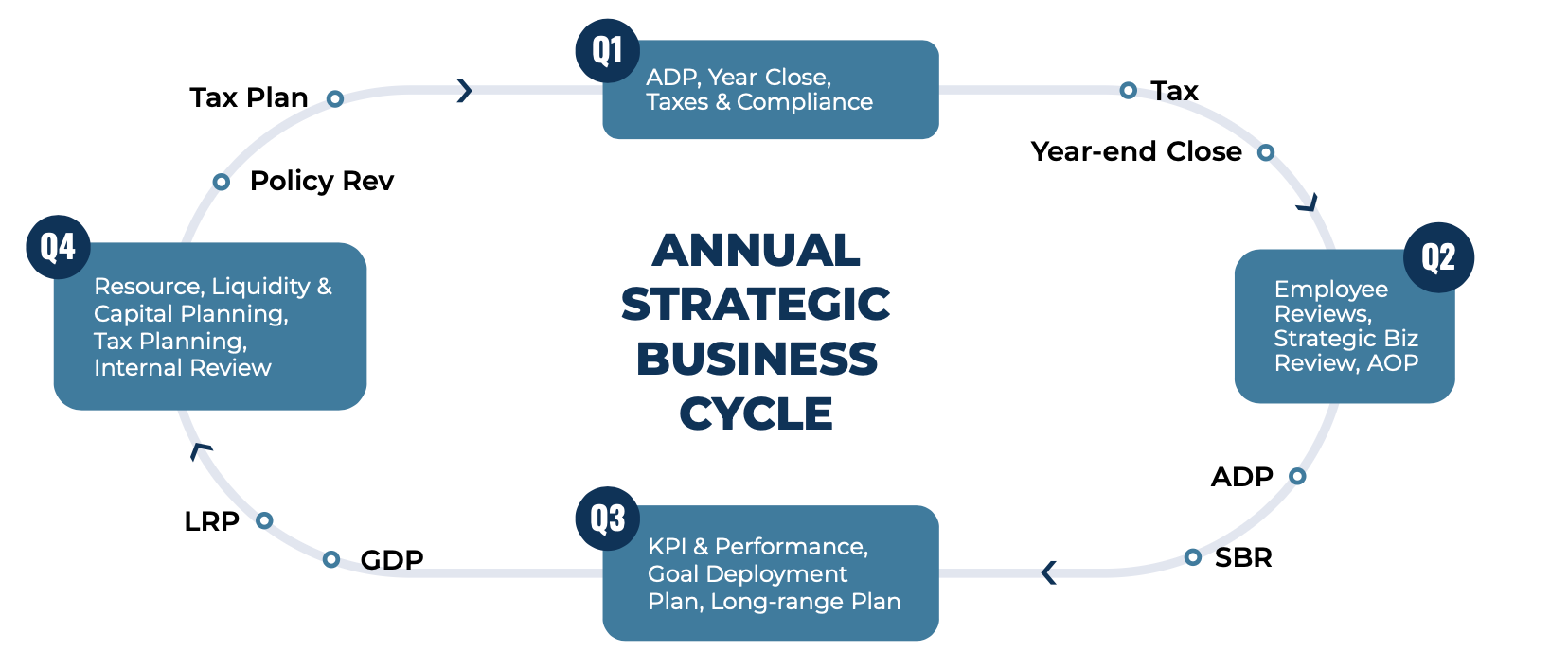
The Annual Strategic Business Cycle - The backbone of CAS
The monthly advisory is powerful when it is based on cadence + rigor + the right people. But the real unlock is connecting the monthly cadence to an annual planning cycle: Long Range Plan > Annual Operating Plan > 12-month Rolling Forecast > Monthly Ops and Finance Calls. That’s how your client stops feeling like they are reacting to the business and start feeling like they are in the driver's seat.
There will be unforeseen risks and opportunities along the way, but the cadence and numerous touchpoints help de-risk business operations throughout the year under your leadership.
Preparing the next generation: the job is changing
As a non-accountant who owns an accounting firm, I understand firsthand the challenges accountants face in offering advisory services. The profession is also being asked to evolve faster than we’re training people or recruiting non-accountants to the profession. Next-generation training needs more than technical accounting and compliance coursework.
They need:
- Technical fluency (systems, processes, AI)
- Communication (explaining causals and tradeoffs simply)
- Critical thinking (stating the obvious vs inference)
- And dealing with Ambiguity (beyond balancing debits and credits)
CAS is different work. And that’s why I believe in structured CAS education, making advisory a competency model to develop and mentor with intention, versus hoping your accounting staff just picks it up.
This is why it’s exciting that Intuit has developed its
Client Advisory Services Foundations Pathway - a
free program that provides 50-hours of hands-on training in the competencies that matter for CAS professionals. Courses include training on: accounting fundamentals, technology and AI, client communication, and financial analysis.
The Future is more Human: Unreasonable Hospitality + AI
As AI and automation accelerate, clients will have more data and more DIY opportunities but not more confidence. CAS is how the profession becomes the trusted partner that helps business owners make strategic decisions in the future. Build a repeatable system and process, use AI to remove busywork, develop and attract the right people, and lead with calm and clarity.
This blog is a paid partnership with Intuit.

Related Blogs: