The Most Common Year-End HR Mistakes and How to Prevent Them
A Practical Guide to Avoiding Payroll, Benefits, and HR Compliance Errors
Every February, after year-end payroll filings, W-2s, 1099s, benefits reconciliations, and compliance reporting are complete, the same issues surface again and again.
The most common year-end HR mistakes rarely come from December itself. They’re the result of small payroll, benefits, and compliance gaps that compound quietly throughout the year.
For growing businesses without dedicated HR or payroll teams, these mistakes are common, not careless.
Payroll systems, HRIS platforms, benefits providers, and tax agencies don’t always stay in sync. This becomes more challenging as:
- Employees move
- Roles change
- Companies expand into new states
The good news? Most year-end HR errors are preventable. You just need consistent, proactive processes throughout the year.
Below, we break down:
- The most common year-end HR compliance mistakes
- Why they happen
- How to prevent them from happening again
W-2 and Payroll Tax Errors That Cause Year-End HR Problems
W-2 and payroll tax issues usually come from the same root problem: misaligned data.
Payroll systems, HRIS platforms, and benefits records often fall out of sync. This happens when:
- An employee moves
- A tax rate changes
- The business expands into a new state
In many cases, tax settings are never updated to reflect these changes.
When these details aren’t correct throughout the year, they show up as incorrect W-2s, wrong taxable wages, and state tax notices.
Common Payroll and W-2 Errors
- Employees taxed in the wrong state after relocating
- Employee addresses not updated promptly
- Incorrect SUTA rates carried over from prior years
- Missing local or municipal tax setups
- Misaligned exempt vs. non-exempt classifications
- Off-cycle payments not processed through payroll
- Fringe benefits missing from taxable wages (HSA, FSA, GTLI, S-Corp health premiums)
How Payroll Errors Impact Your Business
- W-2 corrections and amended filings
- Confused employees and reduced trust
- State tax notices, penalties, and interest
- Time-consuming payroll adjustments
- Increased year-end costs and operational stress
How to Prevent Payroll and W-2 Issues
- Build a quarterly payroll → HRIS → benefits audit. A quick review each quarter helps keep employee data, tax settings, wages, and benefit deductions aligned across systems. This process catches small issues early, before they turn into:
- Incorrect W-2s
- Mismatched benefit totals
- State tax notices
- Update all tax settings immediately when an employee moves. A change of address can shift which state or city taxes apply, which unemployment rate you owe, and whether new registrations are required. Update the tax setup at the time of the move to ensure wages are taxed correctly and to prevent amended filings.
- Update SUTA rates every January because they are subject to change every year. State unemployment tax rates are reassessed annually, and payroll systems don’t always update them automatically. Using the wrong rate, even for one payroll, can trigger underpayment notices and additional penalties.
- Run every off-cycle payment through payroll right away. Handwritten checks, reimbursements, spot bonuses, and late payments should always be run through payroll. This ensures taxes are calculated correctly. If they aren’t, year-end wage totals can be incorrect, and W-2s may need to be fixed.
- Maintain a simple fringe benefits tracker. Items like life insurance over $50,000, car allowances, relocation stipends, and S-Corp owner medical premiums must be added to taxable wages. Tracking them throughout the year avoids scrambling in December to remember who received what.
- Use a classification checklist when promoting or restructuring roles. Promotion decisions and role changes sometimes shift whether someone should be exempt or non-exempt under federal and state overtime laws. A quick classification review prevents misclassification penalties and incorrect wage reporting.
- Use our Guide to Setting Up Payroll for Small Businesses.
Why this matters:
Most year-end mistakes can be prevented with small, consistent habits throughout the year.
Keeping payroll and tax settings up to date helps:
- Protect your employees
- Reduce compliance risk
- Save hours of cleanup during the busiest time of year
Check out our
Year-end compliance & payroll checklist.
Benefits Reconciliation Errors That Create Year-End HR Issues
Benefits-related payroll mistakes often occur because payroll deductions, HR systems, and insurance carriers fall out of sync — especially after Open Enrollment or employee life events.
Common Benefits Administration Mistakes
- Incorrect payroll deductions after Open Enrollment
- Dependents enrolled with carriers but missing from payroll
- Incorrect employer contribution amounts
- Missing benefit waivers leading to unintended enrollments
- Employees on leave not transitioned correctly in benefits systems
The Cost of Benefits Misalignment
- Employees lose coverage or face denied claims
- Incorrect insurance invoices
- Delayed reinstatements
- Overpaying for dependents who shouldn’t be covered
How to Prevent Benefits Reconciliation Problems
- A monthly invoice → payroll deduction audit. Comparing your carrier invoice to payroll deductions each month helps ensure everything matches. It confirms employees are charged correctly and that employer contributions align with the carrier’s records. This quick review can catch:
- Missing deductions
- Incorrect amounts
- Outdated dependents
- Employees still enrolled in waived plans
Catching these early helps prevent billing errors and coverage issues.
- A shared OE change log accessible to your HR/payroll partner. During Open Enrollment, dozens of small changes happen at once. Keeping all elections, waivers, and dependent updates in one shared location ensures nothing gets lost between the benefits platform and payroll. This log becomes your “source of truth,” reduces back-and-forth questions, and prevents missed payroll updates that lead to incorrect deductions.
- A benefits eligibility tracker for employees on leave. Leave status can affect an employee's benefits. It determines whether coverage continues, when premiums change, and when benefits must be stopped or restarted. Keep track of important details like:
- Leave start and end dates
- Grace periods
- Premium responsibilities
Doing this prevents coverage gaps, billing mistakes, and compliance issues, especially for state-mandated leave programs.
- A standard workflow for life events (marriage, birth, divorce, etc.). Life events give employees a limited time to add or remove dependents and adjust benefits. Having a clear, repeatable process for:
- Notifying HR
- Updating documentation
- Adjusting payroll
ensures changes happen on time and in the correct order. This protects employees from denied claims and keeps payroll and carrier records aligned.
Why this matters:
When payroll and benefits don’t match, employees often discover the problem at the worst possible time — during medical appointments or claims.
Ready to get started?
Common 1099 Reporting Mistakes for Contractors
1099 reporting is straightforward only when contractor payments and vendor information are centralized and complete.
Common 1099 Compliance Issues
- Contractors paid through Zelle, Venmo, PayPal, or handwritten checks
- Missing or incomplete W-9s
- Incorrect FEINs that don’t match IRS records
- Contractor payments recorded in accounting systems but excluded from 1099s
- Issuing the wrong form (1099-NEC vs. 1099-MISC)
The Business Impact of 1099 Errors
- IRS mismatch notices
- Delayed filings
- Amended 1099s
- Increased audit risk
How to Prevent 1099 Reporting Errors
- Collect a completed W-9 before the first payment. A W-9 gives you the legal name, address, and tax ID the IRS uses to match payments to the right person or business. If you don’t have this information upfront, you risk issuing incorrect 1099s or getting IRS mismatch notices later.
- Centralize all payments; one system, one owner. When payments to contractors happen through multiple platforms (PayPal, checks, Zelle, credit cards, etc.), year-end totals become incomplete or inconsistent. Running everything through one system with a single person responsible keeps your records accurate and audit-ready.
- Run a mid-year contractor audit to catch missing info. A quick review halfway through the year helps you spot missing W-9s, incorrect addresses, outdated tax IDs, or contractors who should actually be employees. Fixing issues in June is far easier than correcting 1099s in January.
- Use a single tracking sheet for all contractor spending. A simple spreadsheet or dashboard that logs every contractor payment — no matter how small — becomes your source of truth at year-end. This prevents underreporting, duplicate 1099s, and time-consuming reconciliation when filing deadlines are approaching.
Why this matters:
Clean contractor records reduce audit risk and eliminate last-minute year-end scrambles.
HR Compliance Issues: The Small Gaps That Create Big Problems
Many businesses underestimate how many employment laws apply to even small teams — and how frequently those laws change.
Common HR Compliance Gaps
- Missing or expired I-9 documentation
- Required state notices never issued
- Outdated or missing harassment prevention training
- Employee handbooks referencing old laws or unused policies
- Payroll job titles that don’t reflect actual duties
What These HR Compliance Errors Lead To
- Fines during audits
- Legal exposure in disputes
- Inconsistent management practices
- Employee confusion and mistrust
How to Prevent HR Compliance Issues
- Quarterly personnel file audits
- A state-by-state required notice tracker
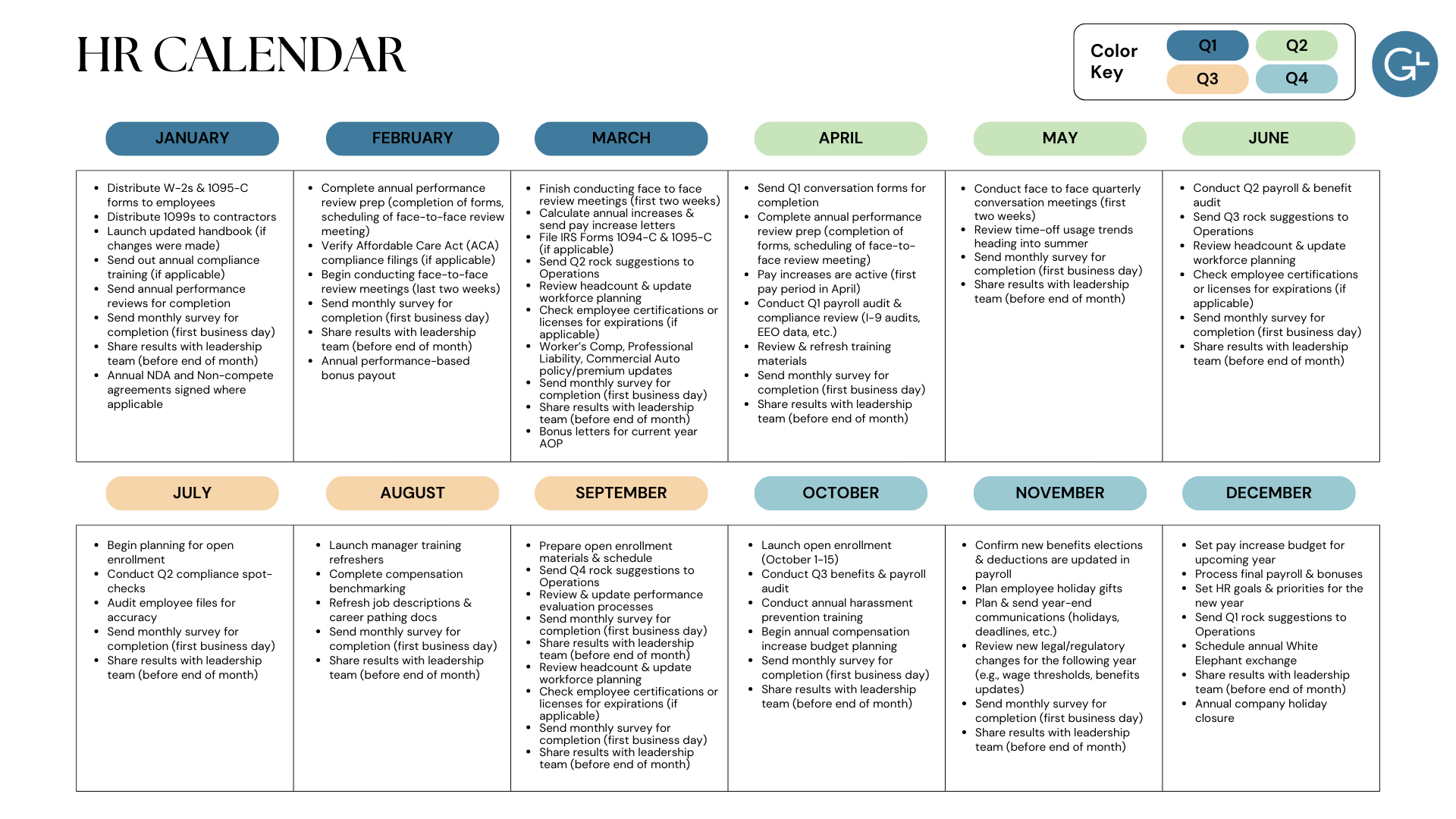
- Annual handbook updates each November
- A training calendar for mandatory courses
- Routine alignment checks between job descriptions, payroll titles, and responsibilities
- Review our Yearly HR Compliance Every Business Should Know
Why this matters:
Outdated HR policies quietly increase risk — often without leadership realizing it until an issue arises.
How GrowthLab Helps Prevent Year-End HR Mistakes
To help businesses avoid recurring year-end HR and payroll problems, GrowthLab Financial’s
People Advisory Services
team provides year-round support, including:
- Quarterly payroll cleanup and readiness checks
- PTO, sick leave, and time-off compliance reviews
- Benefits reconciliation (payroll ↔ carrier)
- Multi-state payroll tax audits and registrations
- Personnel file and I-9 audits
- Contractor classification and 1099 readiness
- Annual handbook updates
- A quarterly HR compliance dashboard tailored to your business
If your organization is tired of reacting to year-end issues, GrowthLab can help you build systems that prevent them altogether.
Key Takeaways
- Proactive Audits: Most year-end errors stem from small data gaps that compound over time. Quarterly payroll audits and monthly benefits reconciliations are the most effective way to catch issues early.
- System Alignment: Ensure payroll, HRIS, and benefits carrier data are synchronized immediately after employee moves, role changes, or life events.
- Tax Accuracy: Prevent W-2 corrections by updating SUTA rates every January and tracking taxable fringe benefits throughout the year.
- Contractor Compliance: Collect W-9s before the first payment and centralize all contractor spending into a single system to simplify 1099 reporting.
- Regulatory Readiness: Maintain a compliance calendar for annual handbook updates and state-specific labor notices to reduce legal exposure.

Get Year Round HR Support
Frequently Asked Questions
What are the most common year-end HR mistakes for small businesses?
The most common year-end HR mistakes include incorrect W-2s, payroll tax errors, benefits deductions not matching carrier invoices, incomplete 1099 reporting, and missing HR compliance documentation. These issues usually stem from payroll, HRIS, and benefits systems falling out of alignment during the year rather than problems that occur in December itself.
Why do year-end payroll and HR issues keep repeating every year?
Year-end issues repeat when small payroll, benefits, and compliance gaps are left unaddressed throughout the year. Changes such as employee moves, role updates, benefit elections, or tax rate changes often aren’t updated across all systems, causing discrepancies that only surface during year-end reconciliation.
What causes W-2 errors and payroll tax notices?
W-2 errors and payroll tax notices are typically caused by outdated employee addresses, incorrect state or local tax setups, wrong SUTA rates, misclassified employees, off-cycle payments not run through payroll, or fringe benefits not included in taxable wages.
How can businesses prevent W-2 corrections and amended payroll filings?
Businesses can reduce W-2 corrections by conducting quarterly payroll audits, updating tax settings immediately when employees move, reviewing SUTA rates annually, processing all payments through payroll, and tracking taxable fringe benefits consistently throughout the year.
Why do payroll deductions and benefits carrier invoices not match?
Payroll deductions and carrier invoices often don’t match when Open Enrollment changes aren’t updated properly, dependents are listed in one system but not another, employer contribution amounts are entered incorrectly, or employees on leave aren’t transitioned correctly in benefits systems.
How can companies prevent benefits reconciliation issues?
Preventing benefits reconciliation issues requires monthly invoice-to-payroll audits, maintaining a shared Open Enrollment change log, tracking benefits eligibility for employees on leave, and using a standardized workflow for employee life events such as marriage, birth, or divorce.
What are the most common 1099 reporting mistakes?
Common 1099 reporting mistakes include paying contractors outside the primary accounting system, missing W-9s, incorrect tax identification numbers, incomplete payment tracking, and issuing the wrong form, such as using 1099-MISC instead of 1099-NEC.
How can businesses avoid 1099 filing errors?
Businesses can avoid 1099 errors by collecting W-9s before issuing payments, centralizing all contractor payments, conducting a mid-year contractor audit, and using a single tracking system to monitor all contractor spending.
What HR compliance issues create the most risk for small businesses?
High-risk HR compliance issues include missing I-9s, unissued state notices, outdated harassment prevention training, employee handbooks referencing old laws, and job titles in payroll systems that don’t reflect actual duties.
How often should HR and payroll compliance be reviewed?
Payroll, benefits, and HR compliance should be reviewed on a regular schedule throughout the year. Quarterly payroll and personnel file reviews, monthly benefits reconciliation, annual handbook updates, and ongoing compliance tracking help prevent issues from accumulating at year-end.
What is People Advisory Services (PAS) at GrowthLab Financial?
People Advisory Services at GrowthLab provides ongoing HR, payroll, and compliance support designed to help businesses stay aligned throughout the year. Services include payroll audits, benefits reconciliation, multi-state payroll tax reviews, personnel file audits, contractor classification support, and HR compliance tracking.
Related Blogs: